

An article by Renée Ridgway, Post-Doc at Aarhus University Department of Business Development and Technology
It’s an off-seasonal hot early morning in May. Renaud arranges a meeting at OSS, a start-up hub close to the République Place in Paris. Between free coffee and Parisian pain au chocolat in a quiet, outfitted office, Renaud discusses Mastodon–– its past, present and its future for around three hours non-stop, without distractions.
It’s an intense deep-dive into a social media start-up, conceived and coded by Eugen who in 2016 became disenchanted by Twitter and its ilk. From there Mastodon’s development takes many twists and turns accordingly. In the past, most decisions were to propel it forward for those only in the know, or for the tech-savvy to set up their own ‘instance’ in the Fediverse.
Simultaneously, its creator turned down most interviews and conference appearances, operating with only a small team consisting of the dedicated to keep it up and running the past years. However, the addition of other members and more financing (it had less than a 1,000,000 € operating budget in 2024) allows it to receive and disseminate funding to employees with financial oversight. Mastodon also will shift its legal status in 2025 to a Belgium AISBL (aka international non-profit) as it fixes bugs and increasingly adapts its decentralized p2p infrastructure to accommodate more users.
Funding of the past year has supported the continuous stream of new users who sign up and it works much like email, where you can choose your provider while staying connected. Echoing shifts of people leaving WhatsApp for Signal, the Fediverse is gaining momentum with Mastodon as its flagship application. The past year, Mastodon received 150,000 Euros from the EU’s NGI Search programme for the development of a ‘bespoke API’ that will enable users to discover content across the rich diversity of the Fediverse.
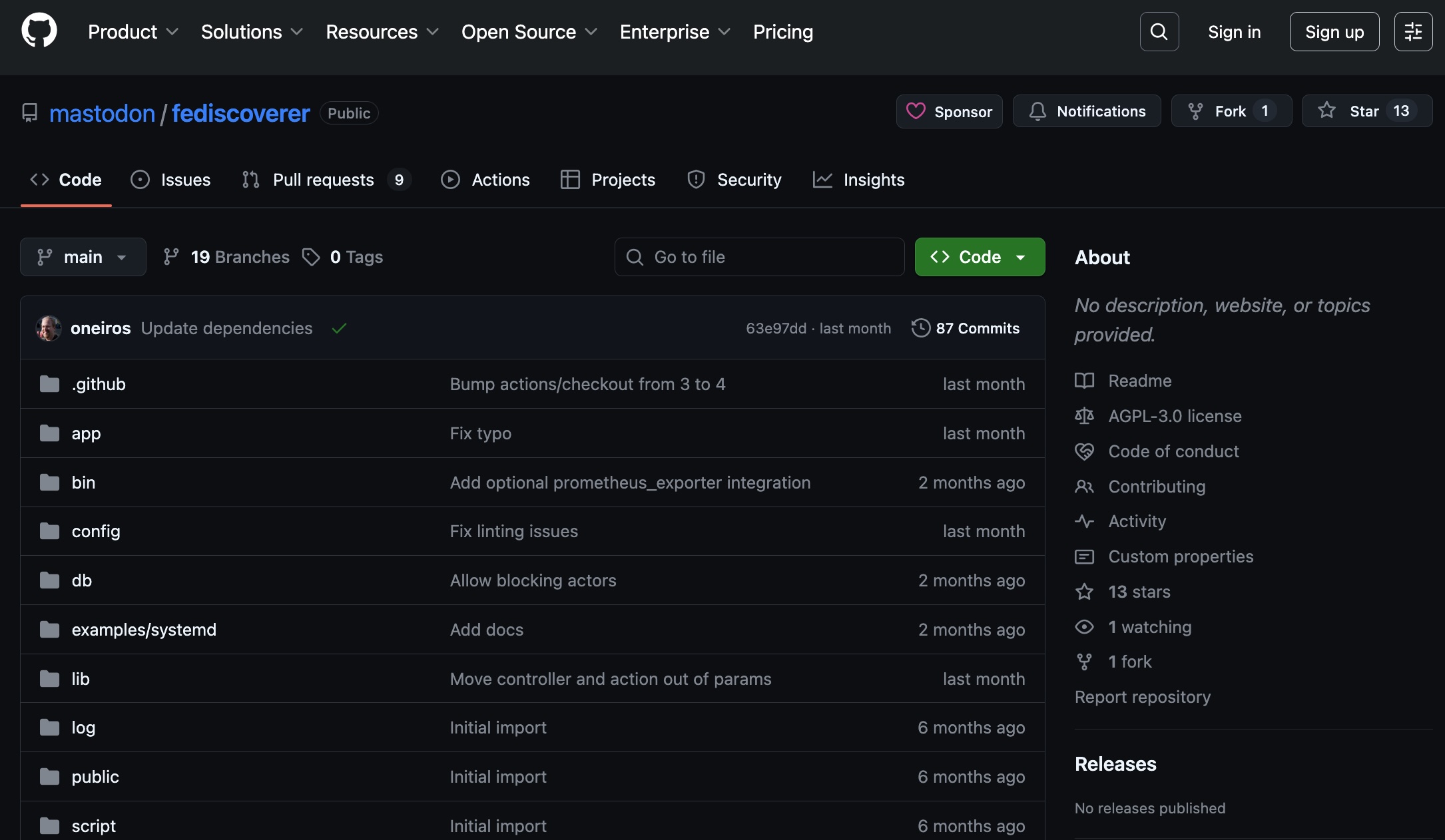
Now available, the Fediverse Search and Discovery Provider–– ‘Fediscoverer’ –– allows Fediverse servers to share publicly discoverable accounts and content to improve search and discovery on individual servers. In line with the decentralised and federated nature of the network, Fediverse platforms like Mastodon have thus made this type of ‘search and discovery’ opt-in and propose a way to publish this information. Providers will only index content that is clearly marked as ‘public.’ Requests to fetch content will be signed by the provider so that servers or even individual users can block these requests on servers that validate this signature. Fediscoverer will respect this privacy setting and only ingest content from creators who opted in to discovery. Instances sending content URLs to discovery providers will need to make sure to only send such content in the first place as well.
Once implemented, the Fediscoverer will increase the quality of content, for those desiring to reach others beyond their individual instances. To be clear, Fediscoverer is not just for Mastodon––the goal is to make it usable and useful to as many Fediverse services as possible. Instead of relays at higher costs where the instance needs to ingest and index everything the relay sends, which takes up processing power and storage, Fediscoverer will do that work for one or more instances.
Yet Renaud is quick to note the organizational complexity, stating that ‘the more generic you make something the more complex it becomes.’ Takeaways from this meeting displayed the intertwining of technology and governance, as the two are not distinct entities––they need to work in tandem to build an alternative and sustainable social network. A library is available for implementation and all code is open source. Documentation from Mastodon is available in the specifications repository. More information about the project can be found at https://www.fediscovery.org/.